
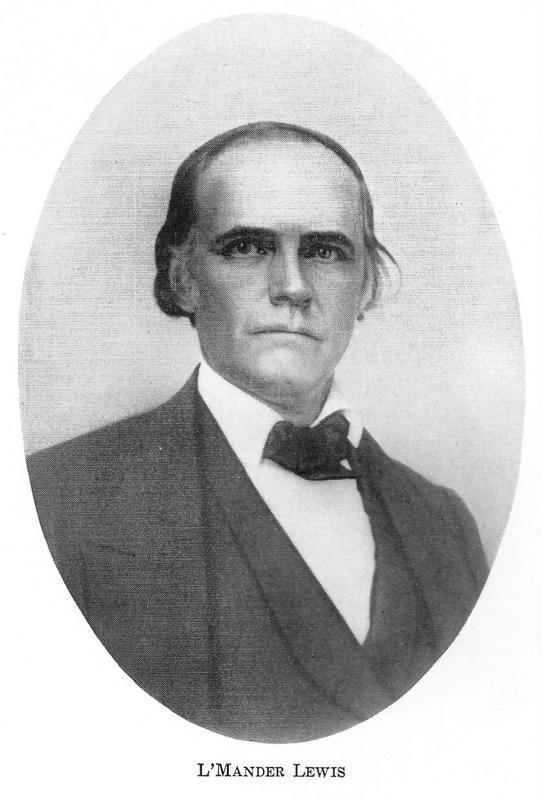
L’Mander Lewis (b. Genessee County, New York, 20 May 1803,[1] d. Valparaiso, Porter County, Indiana, 3 September 1880[2]) was my third great-grandfather. A pioneer physician, he studied medicine in Cincinnati, Ohio, and practiced in several Indiana counties before eventually settling in Porter County.
Several biographical sketches published after his death report that L’Mander was descended from a French Huguenot of the same name who settled in America in the late seventeenth century. However, all available evidence suggests that this story is a myth.
The earliest document I have found referring to L’Mander’s French ancestry is this obituary, printed in The (Valparaiso, Indiana) Messenger on 9 September 1880:
Death of L’Mander Lewis, M. D. Died Friday September 3, 1880 … in city of Valparaiso. Born Genesee Co, NY October 10 1803 and was therefore 77 years old at death. Remote ancestors to America in middle of 17th Century were French [my emphasis]. … He read medicine in Cincinnati and came to this state as early as 1833, settling southwest portion nearly one half century.[3]
A more detailed description of L’Mander’s supposed Huguenot origins are contained in a biographical sketch of his son, Benjamin Franklin Lewis,[*] published as part of a souvenir book about the Chicago World’s Columbian Exhibition of 1893.[4]
Accessible records concerning the earlier history of the Lewis family to which the subject of this review belongs are very few and very meager in detail. It thus becomes necessary to have recourse to tradition [my emphasis], and through this source we learn, with a reasonable degree of accuracy and authenticity, that the great-great-grand father of our subject was L’Mander Lewis, a French Huguenot [my emphasis], who was born in or near Paris, about the year 1663. … In the three years immediately following the revocation of the Edict of Nantes, October 23 , 1685 , L’Mander Lewis … threw the full force of his young manhood into the contest to do battle for his Protestant faith , arraying himself with those brave and devoted men who waged an unequal conflict with the overpowering numbers of Catholic France. … L’Mander Lewis was one of the many brave men who escaped from the mad carnage and fled to Switzerland. From there he came to America, about the close of the seventeenth century—probably in the year 1695 … and here planted the branch of the Lewis family whose record we aim to perpetuate in this connection.
L’Mander Lewis, the brave and dauntless Huguenot, settled in the State of Connecticut, being at that time about thirty-one years of age, and there he married and reared a family. … Lyman had for two or three generations been maintained as a family name, and tradition informs us that this patronymic was borne by the youngest son of the Huguenot progenitor. Lyman Lewis was born in the State of Connecticut and he there remained until he attained maturity, when he married and reared a large family of children, nearly all of whom were boys. He lived and died in his native State, having maintained his abode in the vicinity of New Haven. To the youngest of his twelve children was given the good old Scriptural name of Isaac … Isaac Lewis was born at the parental homestead, near New Haven, Connecticut, in the year 1755 … About the age of seventeen years he removed to Ashfield, Massachusetts, where he became imbued with a burning zeal to go forth and do battle for the cause that was uppermost in all loyal hearts. … he enlisted for service in the Continental army … at which time he was but twenty years of age. … After the close of the war of the Revolution Isaac Lewis … removed to western New York, settling in Genesee county, where he reared a large family of twelve children. The youngest of these was named L’Mander, from a desire to preserve the family name and pay fitting reverence to the memory of the Huguenot founder of the Lewis family in America.[5]
From this sketch, we can derive the following genealogy for L’Mander Lewis of Indiana:
1. L’Mander1 Lewis, b. abt 1663 near Paris, France, emigrated to Connecticut.
2. Lyman2 Lewis (L’Mander1), b. aft. 1695 in Connecticut.
3. Isaac3 Lewis (L’Mander1, Lyman2), b. near New Haven, Connecticut, 1755, removed to Ashfield, Massachusetts, abt. 1772; removed to Genessee County, New York.
4. L’Mander4 Lewis (L’Mander1, Lyman2, Isaac3), b. Genessee County, New York, 1803, d. Valparaiso, Porter, Indiana, 1880.
It is a compelling and believable story. Unfortunately, the tale of L’Mander the Huguenot and his son Lyman is fabricated. There is no evidence of a Huguenot named L’Mander Lewis emigrating to America.
Nor is there evidence that my ancestor L’Mander’s grandfather was named Lyman. Lyman was both a common fore- and surname in Colonial America. The earliest record I have found for Lyman Lewis in America is a birth record from 1776, with father’s name Samuel, and no connection to my L’Mander.[6]
On the other hand, there is every reason to believe that Isaac Lewis was L’Mander’s father.
Isaac Lewis was born at Windham, Connecticut on 20 May 1755, the son of Timothy—not Lyman—Lewis.[7] He served in the Massachusetts militia and the Continental Army during the Revolutionary War. In a deposition given at Hamilton County, Ohio, and dated September 1832, Isaac stated: “when Call’d in to the service I lived in the State of Massachusetts since which I have resided in the States of Vermont New York and from New York I removed to this State—and have resided in this County for fifteen years.”[8] Isaac died at Hamilton County 27 August 1837.[9]
Isaac can be found in the 1790 census of Ashfield, Massachusetts[10] and the 1800 census of Sunderland, Vermont, where his father, Timothy, also lived.[11] . Although I haven’t found any records for Isaac in New York, his statement makes it clear that he lived in that State before moving to Ohio about 1817. He appears in both the 1820[12] and 1830 Ohio censuses.[13]

20 to 29 years, one male 60 to 69 years, one female under age 6, one female 20 to 29 years, and one female 60 to 69 years old (click on image to enlarge)
Although no birth record for L’Mander exists (this would have been unlikely in western New York in 1803) it is probable that L’Mander’s sons, who published most of his biographical material, would have known their grandfather’s name as well as their father’s date and place of birth.
L’Mander’s name is not found in the 1820 or 1830 censuses (where only heads of household were listed), but the numbers and ages of the occupants in Isaac’s household in 1830 suggest that L’Mander was living there, even after his marriage to Mary “Polly” Dodge, that took place in Hamilton County on 26 December 1824.[14]
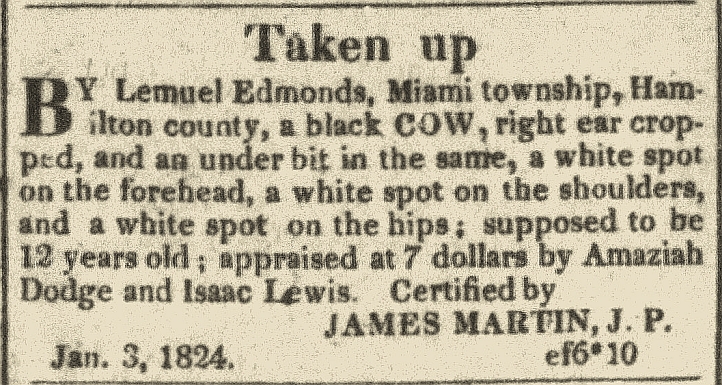
Interestingly, an 1824 advertisement in the Liberty Hall & Cincinnati Gazette suggests that Isaac Lewis and Amaziah Dodge, Mary’s father (or possibly her brother) were in business together.
Isaac Lewis’s ancestry can be traced back to George Lewis (or Lewes) of Brenchley, Kent, England, who died there July 1631. George’s son George (baptized at Brenchley 31 August 1600[15]) emigrated to Massachusetts sometime before 20 September 1635, when he was admitted to the church at Scituate.[16] He later moved to Barnstable, where he died before March 1663/64.[17]
A detailed summary of L’Mander’s ancestry can be found here.
How and why did the myth of L’Mander Lewis, the Huguenot, arise? The biographical sketch of Benjamin Franklin Lewis implies that this was a family tradition. Was the story told to the Lewis children or did they begin the “tradition” after L’Mander’s death? Their knowledge of the true family history apparently ended with their grandfather Isaac.
There is said to be an American Lewis family of Welsh/Irish/Huguenot descent that arrived in North Carolina in the 1730s.[18] The names L’Mander and Lyman do not appear in that family line and there is no evidence that L’Mander’s family knew of this family.
I wonder if the story was created to explain L’Mander’s unique name. Even so, I haven’t found evidence that L’Mander is a French name, although I suppose it could be an old family name. A curiosity is the fact that the name on L’Mander and Mary “Polly” Dodge’s marriage certificate is Marion Lewis—was this his true birth name and he later took on the name L’mander?
Whatever the explanation, the story of L’Mander’s name and Huguenot origins is a good yarn—but a complete myth.
[*] Benjamin Franklin Lewis was the president and founder of the Lewis Publishing Company, a well-known source of county and regional histories in the late nineteenth and early twentieth centuries.
[1] History of Porter County, Indiana: A Narrative Account of its Historical Progress, its People and its Principal Interests (Chicago: Lewis Publishing Company, 1912), 2:408; Online image, Hathi Trust Digital Library (https://catalog.hathitrust.org/Record/011679885 : accessed 18 December 2021).
[2] “Dr. Lewis,” Porter County Vidette, 9 Sep 1880, p. 3; transcribed at Porter County, Indiana (“A Part of the Indiana GenWeb Project”) (http://www.inportercounty.org/Data/Obits/Lewis3552.html : accessed 15 December 2021) >Obituaries & Death Notices >L >Lewis, Dr.(September 9, 1980).
[3] “Death of L’Mander Lewis, M. D.,” transcription in author’s personal notes; citing The (Valparaiso, Indiana) Messenger, 9 September 1880.
[4] World’s Columbian Exhibition Souvenir, Containing a Story of Christopher Columbus and his Discoveries, a Treatise on Illinois and Chicago, also the Columbian Exhibition: Personal Memoirs of Leading Citizens of Illinois (Chicago: North American Engraving and Publishing Co., 1895); image copy, Google Books (https://www.google.com/books/edition/World_s_Columbian_Exposition_Souvenir/6XwSeRV7oFYC?hl=en&gbpv=0 : accessed 15 December 2021).
[5] “Benjamin Franklin Lewis, Chicago,” in World’s Columbian Exhibition Souvenir, Containing a Story of Christopher Columbus …, pp. 153-5.
[6] “Connecticut, Vital Records, Prior to 1850,” database, FamilySearch https://familysearch.org/ark:/61903/1:1:QPMZ-14L1 : accessed 17 December 2021); citing Birth, Compiled by Lucius A. and Lucius B. Barbour, housed at State Library, Hartford, Connecticut; FHL microfilm 007833262.
[7] “Connecticut Town Birth Records, pre-1870 (Barbour Collection)”, database and images, Ancestry (https://search.ancestry.com/search/db.aspx?dbid=1034 : accessed 18 July 2018) >Windham Vital Records >image 221 of 394; imaging White, Lorraine Cook, ed. The Barbour Collection of Connecticut Town Vital Records. Vol. 1-55. Baltimore, MD, USA: Genealogical Publishing Co., 1994–2002.
[8] Isaac Lewis, pension application S.17537; digital images, “U.S., Revolutionary War Pension and Bounty-Land Warrant Application Files, 1800-1900” Ancestry (https://www.ancestry.com/search/collections/1995 : accessed 18 December 2021) >L >Layne, Anthony–Lewis, Willis >Lewis, George–Lewis, Joel >images 358–394 of 1083; citing NARA microfilm publication M804, roll 1556. The quoted statement is contained in images 363 & 364.
[9] Isaac Lewis, pension application S.17537. Isaac’s date of death is recorded in image 360 of 1083.
[10] 1790 U.S. Census, Franklin County, Massachusetts, population schedule, Ashfield, p. 8 (penned), col. 3, line 31, Isaac Lewis; imaged as “United States Census, 1790,” FamilySearch (https://www.familysearch.org/ark:/61903/3:1:33S7-9YYG-TFR?i=1&cc=1803959 : accessed 2 August 2018), Massachusetts > Hampshire > Ashfield > image 2 of 2; citing NARA microfilm publication M637, roll 4.
[11] 1800 U.S. Census, Bennington County, Vermont, population schedule, Sunderland, p. 495 (stamped), line 17; imaged at FamilySearch (https://www.familysearch.org/ark:/61903/3:1:33S7-9RZ6-L61?i=1&cc=1804228 : accessed 18 July 2018), Vermont > Bennington > Sunderland > image 2 of 3; citing NARA microfilm publication M32, roll 51.
[12] 1820 U.S. Census, Hamilton County, Ohio, population schedule, Green Township, p. 156 (stamped), line 2, Isaac Lewis; imaged as “United States Census, 1820,” FamilySearch (https://www.familysearch.org/ark:/61903/3:1:33SQ-GYBC-HQB?cc=1803955 : accessed 24 July 2018), Ohio > Hamilton > Green > image 1 of 8; citing NARA microfilm publication M33, roll 87.
[13] 1830 U.S. Census, Hamilton County, Ohio, population schedule, Whitewater township, p. 273 (penned), line 15, Isaac Lewis; imaged as “United States Census, 1830,” FamilySearch (https://www.familysearch.org/ark:/61903/3:1:33SQ-GYBM-9N2J?cc=1803958 : accessed 24 July 2018), Ohio > Hamilton > Whitewater > image 1 of 20; citing NARA microfilm publication M19, roll 132.
[14] Ohio, Hamilton County, Restored Marriage Records, Vol A2, 1821-1825, p. 365, 2d entry, Marion Lewis & Polly Dodge; imaged as “Marriages records (Hamilton County, Ohio), 1852-1931; restored marriage records, 1808-1873, 1875,” FamilySearch (https://www.familysearch.org/search/film/004016364?cat=292182 : accessed 7 August 2018), image 497 of 556; citing FHL microfilm 344,451, item 2.
[15] Robert S. Wakefield, “George and John Lewis of Brenchley, Kent, England, and Scituate, Massachusetts,” The American Genealogist, 68:24–28.
[16] Amos Otis, “Scituate and Barnstable Church Record,”. The New England Historical and Genealogical Register, vol. 9 (July 1855), p. 280; image copy, Internet Archive (https://archive.org/details/newenglandhistor9185unse : accessed 15 October 2021).
[17] Wakefield, “George and John Lewis of Brenchley, Kent, England, and Scituate, Massachusetts.”
[18] “Descendants of William Lewis of Ulster, Ireland,” Genealogy Web Page for Charles E. Lewis Theme: American Immigration (http://lewis-genealogy.org/genealogy/Lewis/Simeon-99.htm : accessed 18 December 2021).

So glad to have found your article! I am working on my application with the Mayflower Society and they wanted me to withdraw my application because of the Hugonat story from the Lewis Publishing Company. I have presented your article with all the references and I am grateful for all the research that you have done!
Are you a member of the Mayflower Society?
George Lewis, L’Mander Lewis’s son is the next ancestor in our lineage. I had some trouble proving him to be his son but I found an obituary that links him to his brother Sylvester A. Lewis (S A Lewis). I hope I don’t have any further trouble! Ha Ha!
Thank you again for all your help! I would love to hear from you! Wishing you all the best!
Diane Goldie
Hello Diane, I’m glad I was able to help with your application. No, I’m not a Mayflower Society member, although as you can see from L’Mander’s ancestry that there are several Mayflower connections. I’m not surprised you had trouble proving George’s relation to L’Mander, as there were no official records and the Hamilton County Ohio documentation is very thin. If you would like to communicate further, you can reach me through the Contact Link on my personal blog, “Our Casbon Journey,” https://casbon.one-name.blog/wp/.
Regards,
Jon